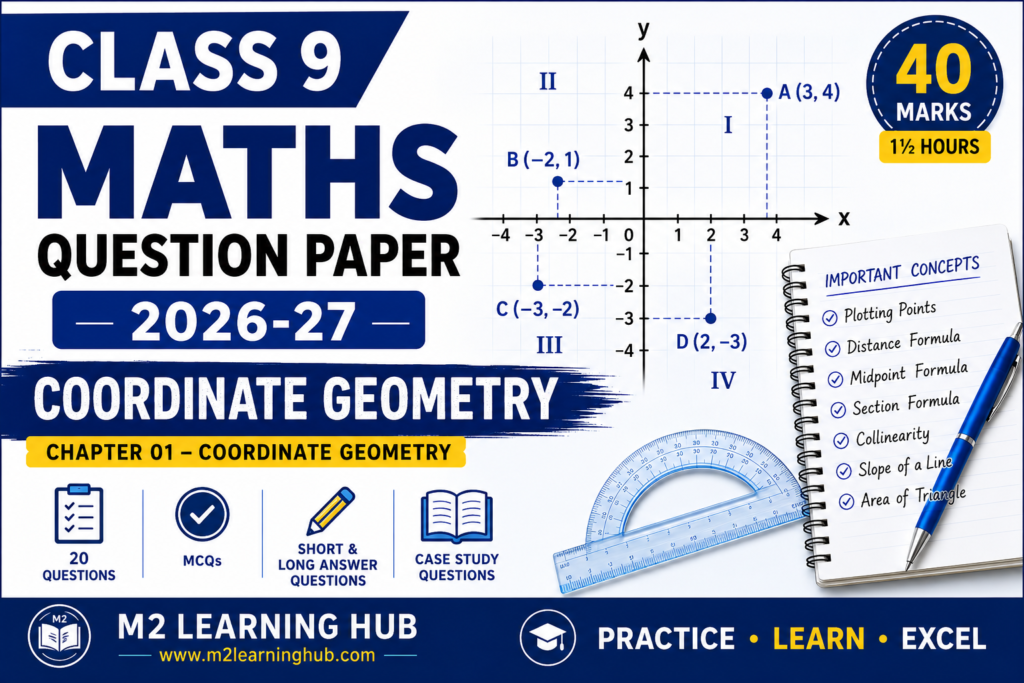
Looking for a Class 9 Coordinate Geometry Question Paper for the 2026–27 academic year? This Mathematics Practice Paper 03 from M2 Learning Hub covers Chapter 01 – Coordinate Geometry and is designed for Class 9 students to practise important concepts and question types.
M2 LEARNING HUB
www.m2learninghub.com
PRACTICE PAPER 03 (2026-27)
CHAPTER 01 – COORDINATE GEOMETRY
| SUBJECT: MATHEMATICS | MAX. MARKS: 40 |
| CLASS: IX | DURATION: 1½ hrs |
General Instructions:
- All questions are compulsory.
- This question paper contains 20 questions divided into five Sections A, B, C, D and E.
- Section A comprises 10 MCQs of 1 mark each. Section B comprises 4 questions of 2 marks each. Section C comprises 3 questions of 3 marks each. Section D comprises 1 question of 5 marks. Section E comprises 2 Case Study Based Questions of 4 marks each.
- There is no overall choice.
- Use of calculators is not permitted.
SECTION – A
Questions 1 to 10 carry 1 mark each.
- A point is equidistant from the lines x = 0 and y = 0, and lies in the third quadrant. Which is possible?
(a) (4, −4) (b) (−4, −4) (c) (4, 4) (d) (−4, 4) - The number of points on the y-axis equidistant from (3, 4) and (3, −8) is:
(a) 0 (b) 1 (c) 2 (d) Infinite - Which point has the maximum distance from the origin?
(a) (6, 0) (b) (4, 5) (c) (3, 7) (d) (2, 8) - The midpoint of the segment joining (p, q) and (−p, −q) is:
(a) (p, q) (b) (0, 0) (c) (p, 0) (d) (0, q) - The distance between (x, 0) and (0, x) is 6√2. Then x equals:
(a) 6 (b) 3 (c) 6/√2 (d) 12 - Which of the following sets of points are collinear?
(a) (2, 2), (4, 6), (6, 10) (b) (1, 1), (2, 4), (3, 9) (c) (0, 1), (2, 5), (4, 8) (d) (1, 0), (3, 2), (5, 7) - If the midpoint of a line segment is (4, 5) and one endpoint is (10, 9), the other endpoint is:
(a) (−2, 1) (b) (6, 4) (c) (−2, −1) (d) (2, 1) - The distance between two points is zero if:
(a) the points lie on the same axis (b) the points are identical (c) the points lie in the same quadrant (d) the coordinates are negatives of each other - Assertion (A): The distance between the points A(p, q) and B(−p, −q) is AB = 2√(p²+q²).
Reason (R): The distance between two points (x₁,y₁) and (x₂,y₂) is given by d = √[(x₂−x₁)² + (y₂−y₁)²].
(a) Both A and R are true and R is the correct explanation of A.
(b) Both A and R are true but R is not the correct explanation of A.
(c) A is true but R is false.
(d) A is false but R is true. - Assertion (A): If the midpoint of the segment joining A(x₁,y₁) and B(x₂,y₂) is the same as the midpoint of the segment joining B(x₂,y₂) and C(x₃,y₃), then A, B, C are collinear.
Reason (R): The midpoint of a line segment joining (x₁,y₁) and (x₂,y₂) is given by M = ((x₁+x₂)/2, (y₁+y₂)/2).
(a) Both A and R are true and R is the correct explanation of A.
(b) Both A and R are true but R is not the correct explanation of A.
(c) A is true but R is false.
(d) A is false but R is true.
SECTION – B
Questions 11 to 14 carry 2 marks each.
- Find a point on the x-axis equidistant from (3, 6) and (7, 6).
- Find the value of k, if the distance between (k, 3) and (3, k) is zero.
- Find a point on the y-axis equidistant from (5, 3) and (−5, 3).
- Find the coordinates of a point whose distances from the x-axis and y-axis are 5 and 8 respectively.
SECTION – C
Questions 15 to 17 carry 3 marks each.
- Show that the points A(2, 3), B(4, 7), C(6, 11) are collinear using the distance method.
- Prove that the triangle with vertices (0, 0), (5, 0), (0, 12) is right-angled.
- Find the midpoint of the line segment joining (c, d) and (−c, d). State its position.
SECTION – D
Question 18 carries 5 marks.
- Prove that the points A(1, 1), B(4, 1), C(5, 3), D(2, 3) are the vertices of a parallelogram, using the distance formula and the midpoint formula.
SECTION – E (Case Study Based Questions)
Questions 19 to 20 carry 4 marks each.
19. Case Study 1 – Coastal Lighthouse Network
A coastal authority has set up three lighthouses at A(1, 1), B(4, 4), and C(9, 9) on its coordinate map of the shoreline. The authority wants to check whether the three lighthouses lie along the same straight coastal route, so that a single beam corridor can connect them. If they are collinear, a control station is to be set up at the midpoint of the two farthest lighthouses.
Fig. 1 – Positions of lighthouses A, B and C
Answer the following questions:
- Using the distance formula, verify whether the points A, B, C are collinear. (2)
- Identify the two farthest lighthouses. (1)
- Find the midpoint of the line joining the two farthest lighthouses. (1)
OR
(c) Find the distance between the two farthest lighthouses. (1)
20. Case Study 2 – Triangular Solar Panel Field
An energy company is laying out a triangular solar panel field with corners at P(3, 2), Q(3, 10), and R(9, 2) on its site coordinate map. The engineers want to verify whether the field PQR is right-angled, and to find the midpoint of the longest side to install a central junction box.
Fig. 2 – Triangular solar panel field PQR
Answer the following questions:
- Verify whether triangle PQR is right-angled. (2)
- Determine which side is the hypotenuse. (1)
- Find the midpoint of the hypotenuse. (1)
OR
(c) Give the coordinates of the junction-box location. (1)
Prepared by: M2 Learning Hub | www.m2learninghub.com
