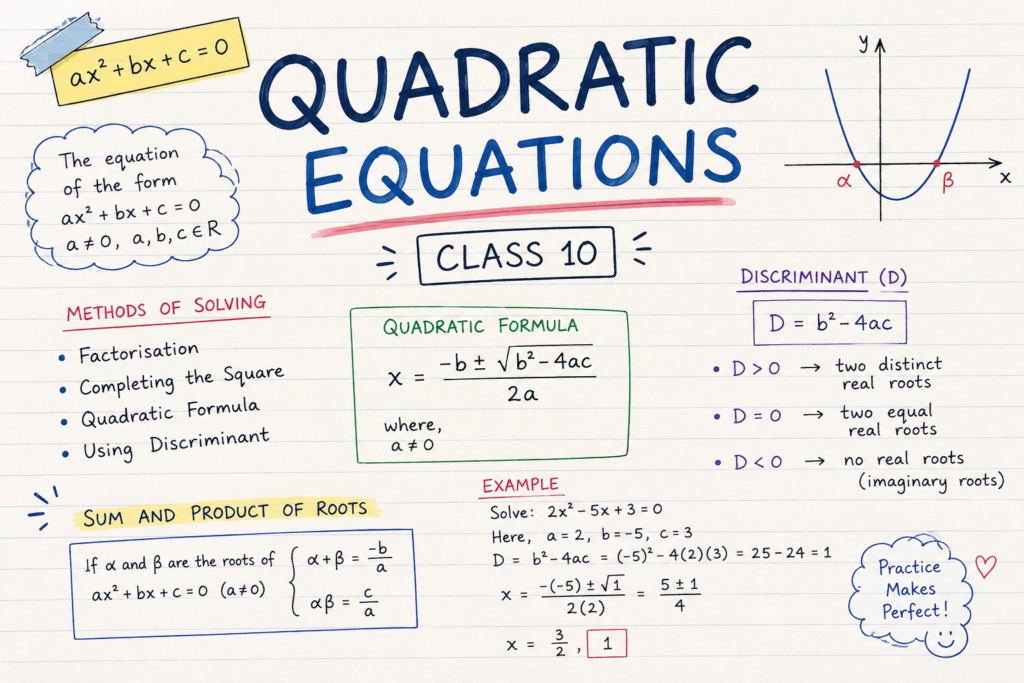
Quadratic Equations is one of the most important chapters in CBSE Class 10 Maths. In this article, you will get complete handwritten notes, important formulas, discriminant concepts, solved examples, and quick revision material for board exam preparation.
| 1 | Introduction to Quadratic Equations | Sec 1 |
| 2 | Standard Form & Key Terminology | Sec 2 |
| 3 | Methods of Solving | Sec 3 |
| 4 | Nature of Roots (Discriminant) | Sec 4 |
| 5 | Relation Between Roots & Coefficients | Sec 5 |
| 6 | Formula Sheet | Sec 6 |
| 7 | Important Solved Questions (Easy) | Sec 7 |
| 8 | Important Solved Questions (Moderate) | Sec 8 |
| 9 | Important Solved Questions (Difficult) | Sec 9 |
| 10 | NCERT Exercise Solutions | Sec 10 |
| 11 | Previous Year Questions (2021–2025) | Sec 11 |
| 12 | Assertion–Reason Questions | Sec 12 |
| 13 | Case Study Questions | Sec 13 |
| 14 | Practice Worksheet | Sec 14 |
| 15 | Common Mistakes & Exam Strategy | Sec 15 |
| 16 | Answer Key | Sec 16 |
A quadratic equation in one variable is a polynomial equation of degree 2. The word “quadratic” comes from the Latin quadratus, meaning “square.”
In its most general (standard) form: \(ax^2 + bx + c = 0\), where \(a,\, b,\, c\) are real numbers and \(a \neq 0\).
The degree of a polynomial equation is the highest power of the variable. Since the highest power in \(ax^2 + bx + c = 0\) is 2, it is a degree-2 (quadratic) equation. If \(a = 0\), the equation reduces to the linear equation \(bx + c = 0\).
| Symbol | Name | Condition | Example: \(2x^2 – 3x + 1 = 0\) |
|---|---|---|---|
| a | Leading coefficient (coefficient of \(x^2\)) | \(a \neq 0\) | \(a = 2\) |
| b | Middle coefficient (coefficient of \(x\)) | \(b \in \mathbb{R}\) | \(b = -3\) |
| c | Constant term | \(c \in \mathbb{R}\) | \(c = 1\) |
(ii) \((2x+1)^2 = 3 \;\Rightarrow\; 4x^2 + 4x + 1 – 3 = 0 \;\Rightarrow\; 4x^2 + 4x – 2 = 0 \;\Rightarrow\; 2x^2 + 2x – 1 = 0\)
(iii) \((x+2)(x-3) = 7 \;\Rightarrow\; x^2 – x – 6 = 7 \;\Rightarrow\; x^2 – x – 13 = 0\)
- Write in standard form: \(ax^2 + bx + c = 0\)
- Find two numbers \(p\) and \(q\) such that: \(p + q = b\) and \(p \times q = ac\)
- Split the middle term: \(ax^2 + px + qx + c = 0\)
- Group and factor out common terms
- Set each factor \(= 0\) and solve
Need \(p + q = -5\) and \(p \times q = 6\) → \(p = -2,\; q = -3\)
\(x^2 – 2x – 3x + 6 = 0\)
\(x(x – 2) – 3(x – 2) = 0\)
\((x – 2)(x – 3) = 0\)
∴ \(x = 2\) or \(x = 3\)
Here \(a = 6,\; b = -1,\; c = -2\). Find \(p + q = -1,\; pq = ac = -12\) → \(p = -4,\; q = 3\)
\(6x^2 – 4x + 3x – 2 = 0\)
\(2x(3x – 2) + 1(3x – 2) = 0\)
\((3x – 2)(2x + 1) = 0\)
∴ \(x = \dfrac{2}{3}\) or \(x = -\dfrac{1}{2}\)
- Divide throughout by \(a\) (if \(a \neq 1\)): \(x^2 + \dfrac{b}{a}x + \dfrac{c}{a} = 0\)
- Move constant: \(x^2 + \dfrac{b}{a}x = -\dfrac{c}{a}\)
- Add \(\left(\dfrac{b}{2a}\right)^2\) to both sides
- Write as: \(\left(x + \dfrac{b}{2a}\right)^2 = \dfrac{b^2 – 4ac}{4a^2}\)
- Take square root and solve for \(x\)
Divide by 2: \(x^2 – \dfrac{5}{2}x + \dfrac{3}{2} = 0\)
\(x^2 – \dfrac{5}{2}x = -\dfrac{3}{2}\)
Add \(\left(\dfrac{5}{4}\right)^2 = \dfrac{25}{16}\) to both sides:
\(x^2 – \dfrac{5}{2}x + \dfrac{25}{16} = -\dfrac{3}{2} + \dfrac{25}{16} = -\dfrac{24}{16} + \dfrac{25}{16} = \dfrac{1}{16}\)
\(\left(x – \dfrac{5}{4}\right)^2 = \dfrac{1}{16}\)
\(x – \dfrac{5}{4} = \pm\dfrac{1}{4}\)
\(x = \dfrac{5}{4} + \dfrac{1}{4} = \dfrac{6}{4} = \dfrac{3}{2}\) OR \(x = \dfrac{5}{4} – \dfrac{1}{4} = \dfrac{4}{4} = 1\)
∴ \(x = \dfrac{3}{2}\) or \(x = 1\)
\(a = 3,\; b = -5,\; c = 2\)
\(D = b^2 – 4ac = (-5)^2 – 4(3)(2) = 25 – 24 = 1\)
\(x = \dfrac{-(-5) \pm \sqrt{1}}{2 \times 3} = \dfrac{5 \pm 1}{6}\)
\(x = \dfrac{5+1}{6} = 1\) OR \(x = \dfrac{5-1}{6} = \dfrac{4}{6} = \dfrac{2}{3}\)
∴ \(x = 1\) or \(x = \dfrac{2}{3}\)
Factorisation → When integer factors are easy to spot.
Completing the Square → When asked to derive or prove a result.
Quadratic Formula → Always reliable; especially when factorisation fails or roots are irrational.
| Condition | Nature of Roots | Formula |
|---|---|---|
| \(D > 0\) | Two distinct real roots | \(x = \dfrac{-b+\sqrt{D}}{2a}\) and \(\dfrac{-b-\sqrt{D}}{2a}\) |
| \(D = 0\) | Two equal (repeated) real roots | \(x = -\dfrac{b}{2a}\) (both roots are the same) |
| \(D < 0\) | No real roots (roots are complex/imaginary) | Not required in CBSE Class 10 |
For equal roots: \(D = 0\)
\(b^2 – 4ac = 0 \;\Rightarrow\; (6)^2 – 4(k)(1) = 0 \;\Rightarrow\; 36 – 4k = 0 \;\Rightarrow\; k = 9\)
∴ \(k = 9\)
For equal roots: \(D = 0\). Here \(a = k+1,\; b = -2(k-1),\; c = 1\)
\(D = [-2(k-1)]^2 – 4(k+1)(1) = 4(k-1)^2 – 4(k+1) = 0\)
\(4\bigl[(k-1)^2 – (k+1)\bigr] = 0\)
\(k^2 – 2k + 1 – k – 1 = 0 \;\Rightarrow\; k^2 – 3k = 0 \;\Rightarrow\; k(k-3) = 0\)
∴ \(k = 0\) or \(k = 3\)
Verification — \(k = 0\): equation becomes \(x^2 + 2x + 1 = 0 \;\Rightarrow\; (x+1)^2 = 0\) ✓
Verification — \(k = 3\): equation becomes \(4x^2 – 4x + 1 = 0 \;\Rightarrow\; (2x-1)^2 = 0\) ✓
If \(\alpha\) and \(\beta\) are the two roots of \(ax^2 + bx + c = 0\) (\(a \neq 0\)), then:
(i) \(\alpha + \beta = \dfrac{-(-5)}{2} = \dfrac{5}{2}\)
(ii) \(\alpha\beta = \dfrac{3}{2}\)
(iii) \(\alpha^2 + \beta^2 = (\alpha+\beta)^2 – 2\alpha\beta = \left(\dfrac{5}{2}\right)^2 – 2\cdot\dfrac{3}{2} = \dfrac{25}{4} – 3 = \dfrac{25}{4} – \dfrac{12}{4} = \dfrac{13}{4}\)
| D Value | Nature of Roots | Example Equation |
|---|---|---|
| \(D > 0\) | 2 distinct real roots | \(x^2-5x+6=0 \;\Rightarrow\; D=1 \;\Rightarrow\; x=2,\;3\) |
| \(D = 0\) | 2 equal real roots | \(x^2-4x+4=0 \;\Rightarrow\; D=0 \;\Rightarrow\; x=2,\;2\) |
| \(D < 0\) | No real roots | \(x^2+x+1=0 \;\Rightarrow\; D=-3 \;\Rightarrow\; \text{no real roots}\) |
Substitute \(x = 3\): \((3)^2 – 4(3) + 3 = 9 – 12 + 3 = 0\) ✓
Yes, \(x = 3\) is a solution.
\(p + q = -3,\; pq = -10 \;\Rightarrow\; p = -5,\; q = 2\)
\(x^2 – 5x + 2x – 10 = 0 \;\Rightarrow\; x(x-5) + 2(x-5) = 0 \;\Rightarrow\; (x+2)(x-5) = 0\)
\(x = -2\) or \(x = 5\)
\(D = (-4)^2 – 4(2)(3) = 16 – 24 = -8\)
\(D < 0\) → No real roots
\(x^2 – 7x = 0 \;\Rightarrow\; x(x – 7) = 0\)
\(x = 0\) or \(x = 7\)
\(x^2 + x – 6 = 0 \;\Rightarrow\; a = 1,\; b = 1,\; c = -6\)
\(4x^2 = 1 \;\Rightarrow\; x^2 = \dfrac{1}{4} \;\Rightarrow\; x = \pm\dfrac{1}{2}\)
\(x = \dfrac{1}{2}\) or \(x = -\dfrac{1}{2}\)
\(D = 0 \;\Rightarrow\; k^2 – 4(9) = 0 \;\Rightarrow\; k^2 = 36 \;\Rightarrow\;\) \(k = \pm 6\)
\(p + q = 5,\; pq = 6 \;\Rightarrow\; p = 2,\; q = 3\)
\((x+2)(x+3) = 0 \;\Rightarrow\;\) \(x = -2\) or \(x = -3\)
\(\alpha + \beta = \dfrac{-(-6)}{1} =\) 6
\(\alpha\beta = \dfrac{8}{1} =\) 8
Already factored. \(x + 4 = 0\) or \(x – 4 = 0\)
\(x = -4\) or \(x = 4\)
Let integers be \(x\) and \(x+1\). Then \(x(x+1) = 306 \;\Rightarrow\; x^2 + x – 306 = 0\)
\(D = 1 + 4(306) = 1225 = 35^2\)
\(x = \dfrac{-1 \pm 35}{2} \;\Rightarrow\; x = 17\) or \(x = -18\) (rejected, as integers must be positive)
The integers are 17 and 18.
\(x^2 + 4x = 5 \;\Rightarrow\; x^2 + 4x + 4 = 5 + 4 = 9\)
\((x+2)^2 = 9 \;\Rightarrow\; x+2 = \pm 3\)
\(x = 1\) or \(x = -5\)
For real roots: \(D \geq 0 \;\Rightarrow\; 16 – 4p \geq 0 \;\Rightarrow\; 4p \leq 16 \;\Rightarrow\;\) \(p \leq 4\) (and \(p \neq 0\))
LHS: \(\dfrac{(x+2) + 2(x+1)}{(x+1)(x+2)} = \dfrac{3x+4}{(x+1)(x+2)}\)
Equation: \(\dfrac{3x+4}{(x+1)(x+2)} = \dfrac{4}{x+4}\)
Cross multiply: \((3x+4)(x+4) = 4(x+1)(x+2)\)
\(3x^2 + 16x + 16 = 4x^2 + 12x + 8\)
\(0 = x^2 – 4x – 8\)
\(x = \dfrac{4 \pm \sqrt{16+32}}{2} = \dfrac{4 \pm \sqrt{48}}{2} = \dfrac{4 \pm 4\sqrt{3}}{2} =\) \(2 \pm 2\sqrt{3}\)
Sum \(= (3+\sqrt{5}) + (3-\sqrt{5}) = 6\)
Product \(= (3+\sqrt{5})(3-\sqrt{5}) = 9 – 5 = 4\)
Equation: \(x^2 – 6x + 4 = 0\)
Let speed \(= x\) km/h. Time \(= \dfrac{360}{x}\). Faster time \(= \dfrac{360}{x+5}\)
\(\dfrac{360}{x} – \dfrac{360}{x+5} = 1\)
\(360(x+5) – 360x = x(x+5) \;\Rightarrow\; 1800 = x^2 + 5x \;\Rightarrow\; x^2 + 5x – 1800 = 0\)
\(D = 25 + 7200 = 7225 = 85^2\)
\(x = \dfrac{-5 + 85}{2} = 40\)
Speed = 40 km/h
\(a=2,\; b=-7,\; c=3.\quad D = 49 – 24 = 25\)
\(x = \dfrac{7 \pm 5}{4} \;\Rightarrow\; x = 3\) or \(x = \dfrac{1}{2}\)
Substitute \(x = \dfrac{1}{3}\): \(3\cdot\dfrac{1}{9} – 10\cdot\dfrac{1}{3} + k = 0 \;\Rightarrow\; \dfrac{1}{3} – \dfrac{10}{3} + k = 0 \;\Rightarrow\; k = 3\)
Product of roots \(= \dfrac{k}{a} = \dfrac{3}{3} = 1\). Other root \(= 1 \div \dfrac{1}{3} = 3\)
\(k = 3\), other root \(= 3\)
\(\alpha+\beta = -1,\quad \alpha\beta = -2\)
\(\alpha^2 + \beta^2 = (\alpha+\beta)^2 – 2\alpha\beta = 1 – 2(-2) = 1 + 4 =\) 5
If \(k = 4\): equation becomes \(0 + 0 + 4 = 0\) → \(4 = 0\) (impossible), so \(k \neq 4\).
For equal roots, \(D = 0\): \([2(k-4)]^2 – 4(k-4)(4) = 0\)
\(4(k-4)^2 – 16(k-4) = 0 \;\Rightarrow\; 4(k-4)\bigl[(k-4) – 4\bigr] = 0 \;\Rightarrow\; 4(k-4)(k-8) = 0\)
\(k = 4\) (rejected) or \(k = 8\). ∴ \(k = 8\)
Let larger \(= x\), smaller \(= y\). \(x^2 – y^2 = 45\) and \(y^2 = 4x\)
\(x^2 – 4x = 45 \;\Rightarrow\; x^2 – 4x – 45 = 0 \;\Rightarrow\; (x-9)(x+5) = 0\)
\(x = 9\) (since \(x\) is a natural number). \(y^2 = 4(9) = 36 \;\Rightarrow\; y = 6\)
The numbers are 9 and 6.
For equal roots, \(D = 0\): \((b-c)^2 – 4(a-b)(c-a) = 0\)
\(b^2-2bc+c^2 – 4(ac-a^2-bc+ab) = 0\)
\(b^2-2bc+c^2 – 4ac+4a^2+4bc-4ab = 0\)
\(4a^2 + b^2 + c^2 + 2bc – 4ab – 4ac = 0\)
\((2a – b – c)^2 = 0 \;\Rightarrow\; 2a – b – c = 0\)
∴ \(2a = b + c\) (Proved)
Let smaller tap \(= x\) hours, larger \(= x-10\) hours. Combined time \(= \dfrac{75}{8}\) hours.
\(\dfrac{1}{x} + \dfrac{1}{x-10} = \dfrac{8}{75}\)
\(75(x-10+x) = 8x(x-10) \;\Rightarrow\; 150x – 750 = 8x^2 – 80x\)
\(8x^2 – 230x + 750 = 0 \;\Rightarrow\; 4x^2 – 115x + 375 = 0\)
\(D = 13225 – 6000 = 7225 = 85^2\)
\(x = \dfrac{115 \pm 85}{8} \;\Rightarrow\; x = 25\) or \(x = 3.75\) (rejected since \(x > 10\))
Smaller tap = 25 hours, Larger tap = 15 hours.
\(\alpha + \beta = \dfrac{q}{p},\quad \alpha\beta = \dfrac{r}{p}\)
\(\dfrac{\alpha}{\beta} + \dfrac{\beta}{\alpha} = \dfrac{\alpha^2 + \beta^2}{\alpha\beta} = \dfrac{(\alpha+\beta)^2 – 2\alpha\beta}{\alpha\beta}\)
\(= \dfrac{\left(\dfrac{q}{p}\right)^2 – 2\cdot\dfrac{r}{p}}{\dfrac{r}{p}} = \dfrac{\dfrac{q^2}{p^2} – \dfrac{2r}{p}}{\dfrac{r}{p}} = \dfrac{q^2 – 2pr}{pr}\)
∴ \(\dfrac{\alpha}{\beta} + \dfrac{\beta}{\alpha} = \dfrac{q^2 – 2pr}{pr}\)
Let length \(= l\), width \(= b\). \(2(l+b) = 80 \;\Rightarrow\; l+b = 40 \;\Rightarrow\; l = 40-b\)
\(lb = 375 \;\Rightarrow\; (40-b)b = 375 \;\Rightarrow\; 40b – b^2 = 375 \;\Rightarrow\; b^2 – 40b + 375 = 0\)
\((b-15)(b-25) = 0 \;\Rightarrow\; b = 15\) or \(b = 25\)
Dimensions: 25 m × 15 m
Let \(t = \sqrt{\dfrac{x}{x-3}}\). Then \(\dfrac{1}{t} = \sqrt{\dfrac{x-3}{x}}\)
\(t + \dfrac{1}{t} = \dfrac{5}{2} \;\Rightarrow\; 2t^2 – 5t + 2 = 0 \;\Rightarrow\; (2t-1)(t-2) = 0 \;\Rightarrow\; t = \dfrac{1}{2}\) or \(t = 2\)
Case \(t = 2\): \(\dfrac{x}{x-3} = 4 \;\Rightarrow\; x = 4x-12 \;\Rightarrow\; x = 4\)
Case \(t = \dfrac{1}{2}\): \(\dfrac{x}{x-3} = \dfrac{1}{4} \;\Rightarrow\; 4x = x-3 \;\Rightarrow\; x = -1\)
\(x = 4\) or \(x = -1\)
\(\dfrac{n(n+1)}{2} = 120 \;\Rightarrow\; n^2 + n – 240 = 0\)
\(D = 1 + 960 = 961 = 31^2\)
\(n = \dfrac{-1 + 31}{2} = 15\) (\(n > 0\))
\(n = 15\)
Let digits be \(x\) (tens) and \(y\) (units). Number \(= 10x + y\)
\(10x + y = 4(x+y) \;\Rightarrow\; 6x = 3y \;\Rightarrow\; y = 2x \quad\cdots(i)\)
\(10x + y = 2xy \quad\cdots(ii)\). Substitute \(y = 2x\): \(10x + 2x = 2x(2x) \;\Rightarrow\; 12x = 4x^2 \;\Rightarrow\; x = 3\)
\(y = 6\). Number = 36
Substitute \(x = 4\): \(2(16) + 4k – 12 = 0 \;\Rightarrow\; 32 + 4k – 12 = 0 \;\Rightarrow\; 4k = -20 \;\Rightarrow\; k = -5\)
Product of roots \(= \dfrac{c}{a} = \dfrac{-12}{2} = -6\). Other root \(= \dfrac{-6}{4} =\) \(-\dfrac{3}{2}\)
From \(\dfrac{1}{p} + \dfrac{1}{q} = \dfrac{1}{r}\): \(\dfrac{p+q}{pq} = \dfrac{1}{r} \;\Rightarrow\; pq = r(p+q)\)
The equation with roots \(p\) and \(q\): \(x^2 – (p+q)x + pq = 0\)
Substituting \(pq = r(p+q)\): \(x^2 – (p+q)x + (p+q)r = 0\) ✓ (Proved)
For equal roots: \(D = 0 \;\Rightarrow\; (p+q)^2 – 4r(p+q) = 0 \;\Rightarrow\; (p+q)(p+q-4r) = 0\)
Since \(p+q \neq 0\): \(p + q = 4r\)
It is of the form \(ax^2 + bx + c = 0\) with \(a = 1 \neq 0\), \(b = -3\), \(c = 2\). Yes, it is a quadratic equation.
\(x^2 – 5x + 2x – 10 = 0 \;\Rightarrow\; x(x-5) + 2(x-5) = 0 \;\Rightarrow\; (x+2)(x-5) = 0\)
\(x = -2\) or \(x = 5\)
\(a=1,\; b=-3,\; c=-1.\quad D = 9 + 4 = 13\)
\(x = \dfrac{3 \pm \sqrt{13}}{2} \;\Rightarrow\;\) \(x = \dfrac{3+\sqrt{13}}{2}\) or \(x = \dfrac{3-\sqrt{13}}{2}\)
\(D = (-3)^2 – 4(2)(5) = 9 – 40 = -31 < 0 \;\Rightarrow\;\) No real roots.
\(D = 0 \;\Rightarrow\; k^2 – 4(2)(3) = 0 \;\Rightarrow\; k^2 = 24 \;\Rightarrow\;\) \(k = \pm 2\sqrt{6}\)
\(D = (-5)^2 – 4(3)(2) = 25 – 24 = \mathbf{1}\)
\(D > 0 \;\Rightarrow\;\) Two distinct real roots.
✅ Common mistake: Forgetting to compute \(4ac\) correctly.
If roots are \(\alpha\) and \(\dfrac{1}{\alpha}\), their product \(= 1\).
\(\alpha\beta = \dfrac{k}{3} = 1 \;\Rightarrow\;\) \(k = 3\)
✅ Common mistake: Using sum instead of product.
Let numbers be \(x\) and \(x+3\). \(x(x+3) = 504\)
\(x^2 + 3x – 504 = 0\)
\(D = 9 + 2016 = 2025 = 45^2\)
\(x = \dfrac{-3+45}{2} = 21\) or \(x = -24\)
Numbers: 21 and 24 (or −24 and −21)
\(D = (4\sqrt{3})^2 – 4(4)(3) = 48 – 48 = \mathbf{0}\)
Two equal real roots. Root \(= \dfrac{-4\sqrt{3}}{8} = -\dfrac{\sqrt{3}}{2}\)
Let speed \(= x\). \(\dfrac{480}{x} – \dfrac{480}{x+8} = 2\)
\(480 \times 8 = 2x(x+8) \;\Rightarrow\; 3840 = 2x^2 + 16x \;\Rightarrow\; x^2 + 8x – 1920 = 0\)
\(D = 64 + 7680 = 7744 = 88^2\)
\(x = \dfrac{-8+88}{2} = 40\). Speed = 40 km/h
\(D = 0 \;\Rightarrow\; k^2 – 4(2)(3) = 0 \;\Rightarrow\; k^2 = 24 \;\Rightarrow\;\) \(k = \pm 2\sqrt{6}\)
Note: \(a^2 + a – 6 = (a+3)(a-2)\)
\(x^2 + 5x – (a+3)(a-2) = 0\)
Split: \(x^2 + (a+3)x – (a-2)x – (a+3)(a-2) = 0\)
\(x[x+(a+3)] – (a-2)[x+(a+3)] = 0\)
\([x+(a+3)][x-(a-2)] = 0\)
\(x = -(a+3)\) or \(x = a-2\)
Let numbers be \(x\) and \(15-x\). \(\dfrac{1}{x} + \dfrac{1}{15-x} = \dfrac{3}{10}\)
\(10(15) = 3x(15-x) \;\Rightarrow\; 150 = 45x – 3x^2\)
\(3x^2 – 45x + 150 = 0 \;\Rightarrow\; x^2 – 15x + 50 = 0 \;\Rightarrow\; (x-5)(x-10) = 0\)
Numbers: 5 and 10
(B) Both are true; Reason is NOT the correct explanation.
(C) Assertion is true, Reason is false.
(D) Assertion is false, Reason is true.
(A) \(x^3 + 2x = 0\) (B) \(x^2 + 1/x = 0\) (C) \(x^2 – 5x + 6 = 0\) (D) \(2x + 1 = 0\)
(A) 16 (B) 0 (C) 8 (D) −8
(A) 5/3 (B) 2/3 (C) −2/3 (D) 3/2
(A) 2 (B) −2 (C) 4 (D) 1
(A) 7 (B) 7/2 (C) 3/2 (D) −7/2
(A) Real distinct (B) Real equal (C) No real roots (D) None
(A) −1 (B) 1 (C) 2 (D) 3
(A) \(x^2 + x – 6 = 0\) (B) \(x^2 – x – 6 = 0\) (C) \(x^2 + x + 6 = 0\) (D) \(x^2 – 5x + 6 = 0\)
(A) 3/5 and −3/5 (B) 3/5 and 3/5 (C) −3/5 and −3/5 (D) 1/5 and 9/5
(A) ±6 (B) ±12 (C) ±9 (D) ±18
\(D = 3 + 4(3)(2\sqrt{3}) = 3 + 24\sqrt{3}\)
\(x = \dfrac{\sqrt{3} \pm \sqrt{3 + 24\sqrt{3}}}{6} \approx 1.14\) or \(x \approx -0.57\)
- Always write standard form first before solving
- For word problems: define variable clearly, box your final answer
- Show discriminant calculation explicitly — it earns step marks
- Write “rejected since [reason]” when discarding a root
- For completing square: show every single step
- \(D > 0\) → Distinct real · \(D = 0\) → Equal real · \(D < 0\) → No real roots
- Sum \(= -b/a\) · Product \(= c/a\) · Equation from roots: \(x^2 – Sx + P = 0\)
- Factorisation works best when \(D\) is a perfect square
- Always verify by substituting roots back into the original equation
MCQs: ×1 mark | Short Answer: ×2 marks | Long Answer: ×4 marks
45–50: Excellent 🌟 | 35–44: Very Good ✅ | 25–34: Good 👍 | Below 25: Revise again 📖
📘 Want more CBSE handwritten notes and premium concept explanations?
Visit: M² Learning Hub
